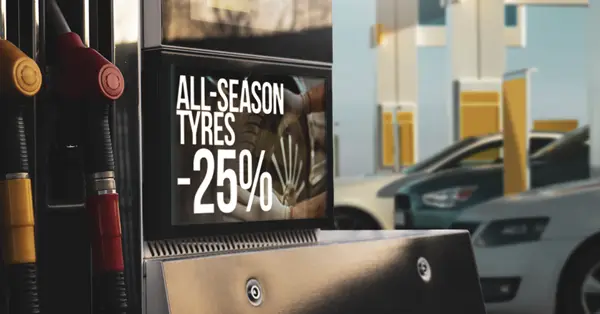
Physical stores have a unique position in retail media. Shoppers are close to the point of purchase, in a real buying environment, and often directly in front of the category or product being advertised.
At the same time, retailers have access to their own customer and transaction data and can connect media exposure with actual purchases. Together, these elements can create a media proposition with genuine commercial value for both advertisers and retailers.
Selling the first campaign, however, does not yet create a media business. The real opportunity begins when individual campaigns develop into a continuous, growing and scalable revenue stream.
Where does in-store retail media revenue come from?
Retailers already have a valuable audience inside their physical stores. Customers visit daily and weekly, and the task is to turn that reach into a media product that advertisers want to buy.
A single screen or display location is not yet a complete media product.
Advertisers need to understand:
- who the campaign can reach
- in what context that contact takes place
- the potential size of the audience
- how the media can be targeted
- how campaign delivery and impact are measured.
The better these questions can be answered, the stronger the commercial value of the media becomes.
Reliable display and software infrastructure is the foundation
In-store retail media depends on the ability to deliver a campaign reliably, in the right place, at the right time and according to plan.
The display network forms the physical distribution layer of the media channel. Screen quality, placement, visibility and operational reliability all have a direct impact on how effectively the media can reach shoppers.
Software turns the display network into a centrally managed media channel. Campaigns can be scheduled, targeted, automated, monitored and reported across the network.
When the network grows to hundreds or thousands of screens, monitoring, remote management, maintenance, campaign quality assurance and technical support are no longer background technical functions. They become part of the quality of the media product itself.
This is particularly important when problems occur. Issues need to be identified quickly, their cause established efficiently and the necessary actions initiated without unnecessary delay.
The larger the network, the more important it becomes to have operating processes and partners that can minimise downtime and its impact on campaigns.
Advertisers must be able to trust that the campaign they have purchased will run as agreed. The purpose of reliable display and software infrastructure is therefore not simply to show content. It must support reliable, measurable and scalable media operations.
Data increases the value of the media
A large store network and high shopper traffic are valuable in themselves, but a retailer's own data makes the media proposition considerably more powerful.
First-party data allows in-store media to move beyond location-based advertising towards audience-based, behaviour-driven and demand-driven media.
The retailer is then no longer selling visibility alone. It is offering advertisers the opportunity to reach relevant audiences in the environment where purchasing actually takes place.
This is one of the most important competitive advantages of in-store retail media.
Growth requires more than individual campaigns
The first media revenue often comes from the retailer's existing suppliers and brand partners. They already have a commercial relationship with the retailer and a clear interest in reaching shoppers close to the point of purchase.
But the growth opportunity extends beyond existing trade relationships.
A well-built media environment can also attract non-endemic advertisers that do not sell products through the retailer but still value its customer audience.
At the same time, the goal should be to move from individual campaigns towards continuous buying.
Once in-store retail media becomes part of brands' annual media planning, retailers can build long-term partnerships, seasonal packages, audience-based products and retail media solutions that combine several channels.
This also makes media revenue more predictable.
Buying needs to scale as well
Once the foundation is in place, the ways in which media is sold and bought can also expand.
Direct sales can be complemented by media agencies, media operators, self-service solutions and programmatic buying.
The aim is to ensure that growth is not limited by the capacity of the retailer's own sales organisation.
The easier it is to integrate in-store retail media into the processes and systems advertisers already use to buy other media, the easier it becomes to scale revenue.
Measurement enables repeat buying
The first campaign may be bought out of interest. Repeat buying depends on results.
Advertisers need to be able to see, at a minimum, how the campaign was delivered, the audience it had the opportunity to reach and, where possible, the effect it generated.
One of retail media's key strengths is that the media operates in the same environment where purchases take place. When campaign impact can be assessed using the retailer's own data, in-store retail media can compete for media budgets on a much stronger basis.
At the same time, common and transparent measurement practices are needed so that advertisers understand what is being measured and how the results are calculated.
IAB Europe is currently working towards more consistent practices for in-store retail media measurement. We examine the current measurement proposals in more detail in a separate article.
When does in-store retail media become a real business?
One successful campaign does not yet create a media business. Nor does a large display network automatically guarantee growing media revenue.
In-store retail media becomes strategically significant when advertisers buy repeatedly, the advertiser base grows and the operation can scale in a controlled way.
The development can be viewed as a progression:
display network → media product → first campaigns → repeat buying → broader advertiser base → scalable media revenue
Technology, data, commercialisation and measurement make this progression possible.
The greatest opportunity in in-store retail media is not the sale of individual campaigns. It is the creation of a continuous and growing media business built around the retailer's physical reach, customer data and store environment.