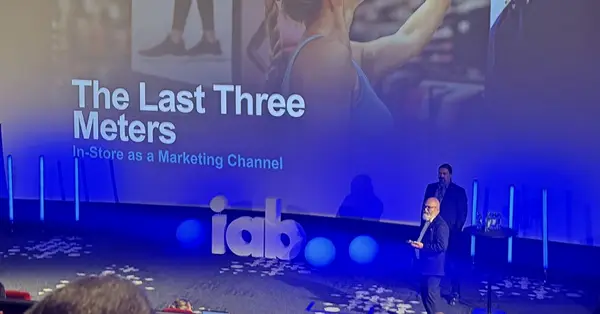
Retail media is rapidly becoming one of the biggest structural shifts in the media industry. The first growth phase, built around e-commerce, is maturing, and the next competitive advantage will be created in physical retail environments. In-store retail media connects data, media, and commerce in a way that brings advertising closer to the actual purchase decision than ever before. This blog was co-authored by Jarno Rantala, Sales & Marketing Director at Craneworks, and Aleksi Rautakorpi, VP, Offering & Marketing, PMO, Retail Media Business (Europe) at ReTALE.
---
Retail media enters a new phase
Retail media is no longer a new phenomenon. It is rapidly becoming one of the most significant structural shifts in the entire media landscape. Forecasts suggest that retail media will surpass television in global advertising spend within the next few years, but the real disruption is no longer just about e-commerce or sponsored products. The deeper transformation lies in how media, data, and commerce are converging into a single system. At the same time, the way advertisers build media investments and evaluate effectiveness is also changing.
The first growth phase of retail media was built around e-commerce. Advertisers bought visibility in search results, product listings, and retailers’ own digital channels because these environments brought advertising closer to the point of purchase than traditional display advertising or social media. At the same time, retail media started attracting budgets away from television, search advertising, social media, and trade marketing. Retail media did not grow through entirely new spending, but by reshaping the logic of media budgets. Advertisers began shifting investments toward environments where visibility and sales impact were more directly connected.
Now, this first wave is maturing. E-commerce retail media has already become an established part of media strategy in many markets, and the greatest growth potential is no longer found solely in digital channels. The next phase of growth will happen in physical stores, where the majority of actual purchases still take place.
Why the next growth opportunity lies in physical stores
Although e-commerce has grown rapidly in recent years, most purchases still happen in physical stores. This is highly significant for retail media because many of the most important purchase decisions are made in-store. Customers compare products, respond to promotions, make impulse purchases, and often choose their final option only after entering the store. This gives physical retail environments a unique advantage for advertisers: the ability to influence customers at the closest possible moment to the actual purchase.
For this reason, retail media cannot reach its full potential without a strong in-store retail media layer. If retail media remains focused only on e-commerce, a large share of real purchasing situations will continue to remain outside the reach of data and activation. From the advertiser’s perspective, the most valuable capability is not simply visibility, but the ability to influence decisions at the exact moment when customers are ready to buy.
Physical retail environments offer three advantages that no other media channel can fully replicate.
The first is the real purchase situation. This is no longer about interest or intent, but about the moment when the customer is actively making a purchase decision and ready to spend money.
The second advantage is product proximity. Influence happens in the exact environment where products are physically in front of the customer and alternatives are being compared in real time.
The third, and perhaps most significant advantage, is the ability to enable closed-loop measurement, where advertising exposure can be directly connected to actual sales outcomes. This creates a completely different level of understanding around campaign effectiveness compared to many traditional media channels.
These factors are exactly what make in-store retail media such an attractive growth platform. This is not simply about adding new advertising surfaces into stores. It is about building a system where data, media, and commerce are combined into one measurable ecosystem.
Most in-store advertising is not yet retail media
Many in-store display networks may look like retail media on the surface, but in practice they still function more like indoor digital out-of-home advertising. Even though the environment is located inside stores, the operating logic often resembles traditional DOOH advertising more than truly data-driven retail media. The conversation still focuses heavily on screen counts, visibility, and network scale, even though the real competitive advantage only emerges when data, targeting, and measurable business impact are introduced.
The biggest shortcomings typically appear in three areas.
The first problem is screen-centric thinking. Network scale is an important foundation, but the number of screens alone does not make an environment retail media. If the system cannot utilize purchase data or optimize messaging on a store-by-store basis, it is essentially just a digital media surface.
The second issue relates to data integration. Many environments are not connected to loyalty data, category sales, or store-specific behavioral insights. As a result, targeting remains generic and advertising cannot be optimized based on actual purchasing behavior. This significantly limits the true value of retail media for both retailers and advertisers.
The third problem is measurement. Too often, reporting stops at the number of times an advertisement was displayed on a screen. The real sales impact remains invisible, and advertisers are left without an answer to the most important question: did the campaign actually influence purchasing behavior? Without this connection, in-store advertising easily remains an isolated media channel whose role is difficult to justify as part of a broader media mix.
This is why much of today’s in-store advertising still functions more as media inventory than as genuinely data-driven retail media. The potential is enormous, but the market is still in a developmental phase.
What separates digital signage from true retail media
The real transition to retail media requires the combination of three elements: data, targeting, and measurement. Only then does in-store media begin to operate according to the same logic as modern online retail media.
Data must reveal who the customer is, what they buy, and in what shopping context they operate. Targeting must enable the right message to be shown in the right store at the right time. Measurement must prove whether advertising created a real impact on sales and customer behavior. When these elements are combined, in-store media shifts from visibility to measurable business impact.
In 2026, the winning retail media model will no longer be built around isolated channels. Successful players will create unified retail media layers where on-site, off-site, and in-store retail media all operate through the same data, targeting, and measurement framework. This enables campaign optimization across channels and provides advertisers with a unified view of what truly drives sales. Retail media is evolving from a standalone media channel into part of a broader commerce infrastructure.

Tokmanni’s pilot demonstrates where the market is heading
In Finland, one of the most interesting examples of this development is Tokmanni’s decision to open its digital display network to programmatic buying. This is not just about introducing new media inventory, but about a much larger shift in how in-store media integrates into the wider media ecosystem.
Digital signage has long been close to retail media, but in many ways the development has remained incomplete. In Tokmanni’s pilot, the most significant change is not merely programmatic buying itself, but especially measurement.
Traditionally, one of the biggest challenges in in-store media has been validating audience contacts. A single screen impression does not equal a real customer contact, and an ad playing on a screen does not automatically reveal any actual impact.
Tokmanni’s model is based on measuring real customer encounters rather than simple screen impressions. This makes campaign reach comparable with other media channels and brings in-store media closer to the standards advertisers already expect from digital advertising. At the same time, buying becomes significantly easier. When advertising can be purchased through the same tools as other media, in-store media starts integrating naturally into standard media planning instead of remaining an isolated experiment.
In addition, the retailer retains control over its own environment, enabling a safe and controlled advertising ecosystem. This is a critical component of retail media credibility, since retailers do not want to lose control over environments that are also part of the customer experience.
When buying, measurement, and governance are properly established, in-store retail media evolves from an interesting experiment into a serious component of the media mix. At the same time, it raises expectations across the entire market. Once one major retailer succeeds in building a credible and measurable in-store retail media network, others must respond to the growing expectations.
The next retail media advantage will be built in-store
Retail media no longer means simply advertising placements in e-commerce environments. It means a system where media, data, and commerce are connected into one integrated ecosystem. That is precisely why the next major competitive advantage will be built inside physical retail environments.
The companies capable of combining data, activation, and measurable sales impact into one unified system will define the next phase of retail media growth. At the same time, the way media is purchased, optimized, and evaluated will fundamentally change. In-store retail media is no longer an isolated addition within a media plan. It is becoming part of a broader ecosystem where marketing and commerce are directly connected.
Craneworks is building the technical and content foundation for in-store retail media for Finland’s leading retail operators. Its sister company, Doohlabs, develops the In-Store IMPACT platform, which combines data, activation, and measurement into a truly measurable in-store retail media ecosystem.
ReTALE is the leading end-to-end retail media service provider and developer of open retail media networks for B2C companies.