In-store retail media in the Nordics is moving beyond experimentation and into practical execution. Within the store environment, data, content, and shopper intent converge in ways that make media more impactful and create new opportunities for business growth.
The development of In-store retail media has entered a new phase. Until recently, the conversation focused largely on opportunities, pilots, and isolated implementations. Today, the focus is shifting toward execution. Across the Nordics, we are seeing increasingly practical applications where In-store retail media is directly linked to business objectives and day-to-day retail operations.
The opening of Tokmanni’s digital screen network to programmatic buying this spring demonstrated that the technical foundations are beginning to take shape. The next critical differentiators will be content quality and customer experience.
At the same time, digital media is facing challenges that have altered its role. Targeting precision has weakened, the reliability of data is increasingly questioned, and consumers have become more critical of advertising. In this environment, the physical store offers something fundamentally different. The opportunity is not simply about reach, but about influencing shoppers when purchase intent is already high and decisions are being made in real time.
The Store Remains at the Heart of Commerce
This topic was discussed in our joint blog in May.
In the Nordics, the store is far from a relic of the past. It remains a central part of consumer purchasing behaviour. A significant share of purchase decisions is still made in-store, making it one of the few environments where media can have a direct and measurable impact on outcomes. Despite this, media investments continue to be heavily concentrated in digital channels.
This imbalance creates a significant opportunity for retailers and brands that can make better use of existing shopper traffic and seamlessly connect commerce and media.
Influence Happens at the Point of Purchase
This topic was discussed in our joint blog in May.
The unique value of the store becomes most apparent at the moment of influence. Consumers rarely make decisions through a purely analytical process. Instead, they respond quickly to stimuli that guide attention and shape choices. Visual cues, motion, and context play a decisive role in determining what captures attention and ultimately ends up in the shopping basket.
Digital screens bring flexibility and dynamism to communication, enabling content to adapt to the situation and context. In Nordic retail environments, where clarity, simplicity, and aesthetics are highly valued, content quickly determines whether an execution succeeds or fails.
In-store retail media Is Not a Separate Layer
This topic was discussed in our joint blog in May.
Perhaps the most important shift is one of mindset. In-store retail media can no longer operate as a standalone function. It must be integrated into the core of retail operations. In practice, this means media is not treated as an add-on but designed as part of the commercial strategy from the outset. When campaigns, assortments, and sales objectives are planned, the role of media should be defined simultaneously.
When In-store retail media is directly connected to category strategy and campaign planning, its impact becomes far more tangible. It moves beyond visibility and brand-building to become an active driver of sales. When executed effectively, it can support specific product categories, guide shopper flows within the store, and amplify campaign performance in ways that traditional in-store communication alone cannot achieve.
If In-store retail media remains disconnected from broader business objectives, contradictions quickly emerge. Visibility may increase and campaigns may appear successful, yet the actual commercial impact remains unclear. This is one of the key reasons many early pilots failed to deliver the expected results.
Measurement Is Evolving Rapidly
This topic was discussed in our joint blog in May.
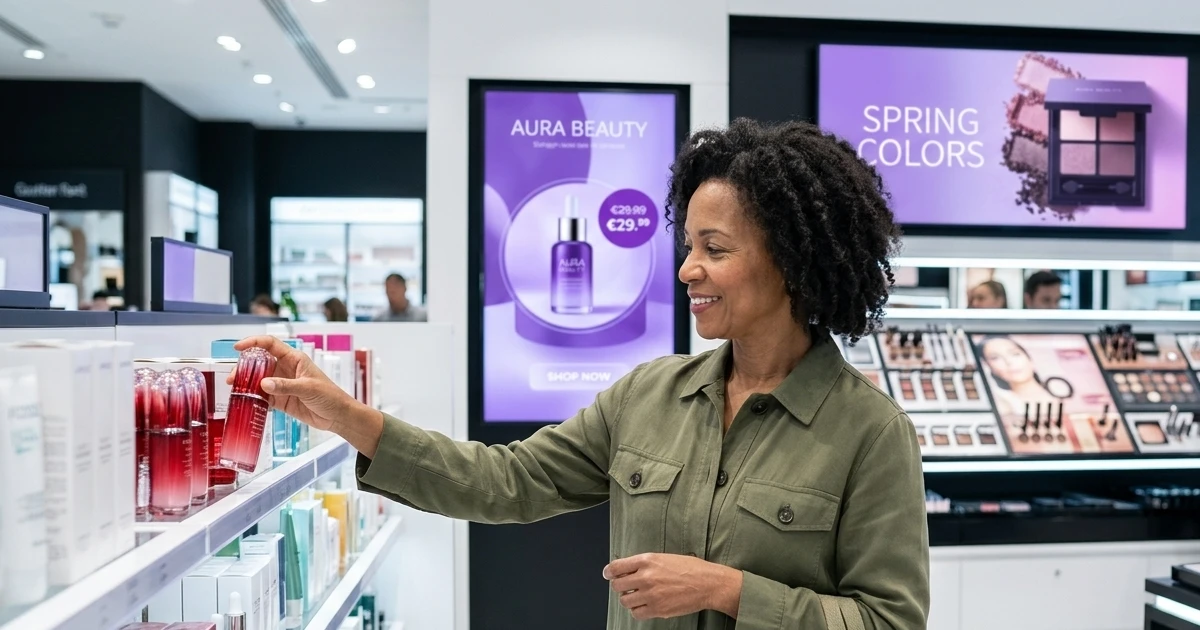
Advances in measurement are among the most important factors enabling In-store retail media to evolve from experimentation into a scalable business model. In the Nordics, access to high-quality and comprehensive data provides a realistic understanding of how in-store media influences sales and shopper behaviour. This allows decision-making to be based on evidence rather than assumptions.
Increasingly, measurement is built on the combination of multiple data sources. Sales data demonstrates commercial impact directly at the point of sale, customer data provides insight into shopper behaviour, and various sensors and technologies help identify movement patterns and attention within the store. Together, these sources create a holistic view that supports continuous optimisation.
At the same time, the role of measurement is changing. It is no longer a post-campaign exercise but an ongoing process that guides decisions in real time. In this respect, the physical store offers an interesting counterbalance to digital advertising, where measurement has become increasingly complex and, in some cases, less transparent.
Content Determines Success
While technology enables a great deal, content ultimately determines whether In-store retail media succeeds or fails. This is particularly true in the Nordic context, where consumers are accustomed to clear, efficient, and functional shopping experiences. Communication must be immediately understandable and provide genuine value.
Content that performs well in-store differs fundamentally from content designed for other channels. It is typically shorter, more visual, and more closely tied to context. Its role is not to communicate everything but to direct attention and support decision-making at precisely the right moment. Achieving this requires a deep understanding of shopper behaviour, store dynamics, and the intelligent use of data. Content should reach the right audiences, at the right time, in the right place, and alongside the right products.
One of the most common mistakes is simply repurposing content from digital channels for the store environment. In many cases, the message fails to resonate or goes unnoticed altogether. Successful content is designed specifically for the in-store context, where attention is limited and decisions are made quickly.
At its best, content is built systematically. Seasonal calendars determine when brands need to be present, shopper motivations define what should be communicated, and creative concepts determine how the message is delivered most effectively.
Trust Is a Key Factor
Consumer trust in retailers is exceptionally high across the Nordics, creating a strong foundation for In-store retail media. Shoppers are generally willing to engage with messages in-store without inherent scepticism, provided those messages are perceived as relevant and useful.
This also places high demands on execution. If communication is perceived as intrusive, irrelevant, or overly aggressive, the reaction is swift and negative. Unlike in digital environments, shoppers cannot simply scroll past a message in-store, making the experience significantly more sensitive.
For this reason, opening media inventory to advertisers does not mean relinquishing control. A curated, deal-based sales model combined with content pre-approval ensures that only content designed for the retail environment and supportive of the shopping experience reaches the store. In this way, governance also serves as a safeguard for content quality.
When executed successfully, the outcome is the opposite. Advertising supports purchasing decisions, simplifies choice, and adds value to the overall shopping experience. At its best, it feels like a natural part of the store environment rather than an interruption.
The Next Phase Is Scale
In-store retail media in the Nordics has reached a level of maturity where individual pilots are no longer enough. The focus is now shifting toward scale. Proven models are being rolled out more broadly and integrated into daily business operations. Early adopters have already reached this stage, while for many others it represents the next critical step toward stronger returns and greater operational efficiency.
Scaling requires clear operating models and productised solutions. Without them, efforts can easily become fragmented and difficult to manage. Standardised operating models make it possible to deploy In-store retail media systematically across stores, categories, and campaigns through a data-driven approach.
Ultimately, scalability depends on media buyability. IAB Finland’s DOOH guidelines define what buyers expect: comparable audience metrics, loop and spot information, inventory availability, creative specifications, and clear booking processes. Many retail media networks still do not fully meet these requirements. Productisation is primarily an operational challenge rather than a technology project. This is where ReTALE creates value for the media it represents, including Tokmanni, acting as both a productisation partner and sales channel that connects retail media inventory with advertisers and media agencies.
At the same time, the ability to deliver the right content in the right place at the right time is becoming increasingly important. Technology and data enable a great deal, but true competitive advantage comes from the ability to seamlessly combine the store experience, advertising, and data into a unified ecosystem that continuously generates measurable business value.
The potential of scale is demonstrated by the omnichannel collaboration between Kouvolan Lakritsi and Tokmanni within ReTALE’s retail media ecosystem. The store environment, promotional leaflet, and digital channels were aligned around a shared commercial objective. The result was a 38% increase in sales during the campaign period. When collaboration is systematic and holistic, visibility translates into measurable commercial outcomes.
The Store Is Already Media
The store is no longer just a point of sale. It is rapidly becoming one of the most valuable media environments available to brands.
The technical foundations are being established, measurement capabilities continue to evolve, and buyability is improving. The next stage of development is no longer about technology but about media planning. As retail media matures, its role within agency media strategies will continue to grow. In the future, media plans will not be built separately around digital and physical channels, but around the combined strengths of both.
In this future landscape, In-store retail media is no longer an alternative or supplementary channel. It becomes an integral part of a unified ecosystem where marketing, commerce, and data work together to drive measurable business outcomes.
We will return to this topic with research-based insights at the IAB Finland Retail Media Summit on 2 September 2026.
Craneworks builds the technical and content foundations of In-store retail media for Finland’s leading retail organisations. Sister company Doohlabs develops the In-Store IMPACT platform, which combines data, activation, and measurement into a single measurable ecosystem. ReTALE operates as an end-to-end retail media service provider, productising and selling the advertising solutions of the media networks it represents to advertisers and media agencies.